Showing posts with label country/Spain. Show all posts

Friday, January 22, 2010

WBW #65: Snow Day Wines - Bodegas El Nido 2003 Clio Jumilla

Clio (2003)
Bodegas El Nido
Monastrell 70% | Cabernet Sauvignon 30%
Jumilla DO, Spain
This month's Wine Blogging Wednesday topic (No. 65) hosted by Michelle Lentz was choosing a wine that you'd enjoy drinking during a full out precipitous attack of the white stuff. Thankfully, since moving to Oregon I've only had to "endure" the snow once, while I know back in Ohio and most of the Midwest in general they got pretty much slammed. Thanks Lake Erie!

That said, I think I had a pretty good idea as to what kind of wine I was in need of - big body, dried fruits, and a warmer level of alcohol. My first choice? Port of course - and I think a lot of people turned there at first. But then something shiny caught my attention. A bottle from El Nido (The Nest) winery in Spain. The pearlescent label was really familiar, and it turns out I sampled another of their wines in my Spanish Wine course last year.

Thursday, January 21, 2010

Spanish Wine Dinner at West Cafe

Tuesday night I headed out with some friends to Portland's West Cafe. There we enjoyed a six course dinner paired with different Spanish wines. Our group had two vegetarians (me included) and one vegan. So we really got the full gamut of offerings at our table. Overall the pairings were very well done, and so I'd like to share the menu with you and some of my comments.

Sunday, September 13, 2009

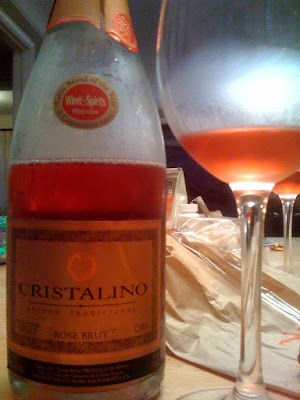
Quick-Sip: Think Pink, part 1

Cristalino Rosé Brut (NV)
Bodegas Juame Serra
Pinot Noir 60% | Trepat 40%
Cava (Costers del Segre or Conca de Barberá D.O.)

Saturday, September 5, 2009

Quick-Sip: 7 Across: Tempranillo in the Duero

Legaris Crianza (2005)
Legaris
Tinta Fina (Tempranillo)
D.O. Ribera del Duero

Friday, September 4, 2009

Quick-Sip: Spanish pink bubbles

Pinot Noir Brut (NV)
Codorníu
Pinot Noir
D.O. Cava

Thursday, September 3, 2009

Quick-Sip: Tempranillo/Cabernet blend from La Mancha

Altozano (2006)
Finca Constancia
Tempranillo 65% | Cabernet Sauvignon 35%
La Mancha (Vino de la Tierra de Castilla)

Wednesday, September 2, 2009

Quick-Sip: 3 French Grapes in 1 Aragòn Blend

Gran Vos Reserva (2005)
Viños del Vero
Cabernet Sauvignon | Merlot | Pinot Noir
D.O. Somontano

Tuesday, September 1, 2009

Quick-Sip: Navarran Red Blend, the Elder

Barón de Magaña (2004)
Bodegas Viña Magaña
Merlot 50% | Cabernet Sauvignon 30% | Tempranillo 10% | other 10%
D.O. Navarra

Monday, August 31, 2009

Quick-Sip: Navarran Red Blend

Magaña Calchetas (2006)
Bodegas Viña Magaña
Merlot | Cabernet Sauvignon | Malbec
D.O. Navarra

Thursday, August 27, 2009

Travelling to Spain without leaving NE Ohio

Last weekend I had the opportunity to explore the many diverse regions of Spain and learn about the wines that each produce. Hosted by the Wine Academy of Spain our class was treated to three intense days of learning and tasting over seventy wines.

The Wine Academy of Spain was started by Pancho Campo, Spain's first recipient of the Master of Wine (MW) title. The Academy was founded to teach and train wine professionals, help promote Spain's wine and tourism industries, and through a special forum bring to light the effects of climate change on wine.

As part of the Academy's 2009-2010 tour, Cleveland and eleven other U.S. Cities were scheduled to host the Spanish Wine Education program. Ryan and Gabriella Opaz of Catavino , an educational website that promotes Iberian wine, food, and culture, offered the chance for an interested blogger in each city to take part in the course. Having traveled to and fallen in love with all Spain has to offer, I jumped at this exciting opportunity. To my delight, I was able to attend the three day class at The Cleveland Wine School, owned by Marianne Frantz, Certified Wine Educator.

Monday, August 17, 2009

Quick-Sip: Red Duero Blend

Rívola (2006)
Abadía Retuerta
Tempranillo | Cabernet Sauvignon
Duero Valley, Spain

Thursday, August 6, 2009

A modern romance of the white grape variety

Con Class Rueda (2007)
Sitios de Bodega
60% Verdejo | 15% SB | 25% Viura
Rueda, Spain
Verdejo - a bold, acidic grape reared on the arid plateaus of Spain. Sauvignon Blanc - a flirtatious, aromatic white French variety cultivated in the classiest neighborhoods of Bordeaux. Two star-crossed lovers separated by the Pyrenees and kept apart speaking two different languages of love... that was until "Rueda." Imagine that in big, bright, flashing, neon lights. It would definitely sell. Despite the lack of singing, choreography, and melodrama I'd say we've got the vinous version of West Side Story on our hands here.

While I wait for Broadway and Hollywood to flock to my door to get the exclusive rights, I'll focus more on a yummy new Spanish wine I had the other day - Con Class Rueda produced by Sitios de Bodega.

Tuesday, July 28, 2009

Reprieving DO Montsant of Priorat copy-cat status

Can Blau Montsant(2006)
Cellars Can Blau
40% Mazuelo (Carignan) | 40% Syrah | 20% Garnacha (Grenache)
DO Montsant, Spain
Spain's system of classifying wine regions isn't as old as France's, however it can sometimes be just as confusing. Denominacíon de Origen (DO) laws were first enacted in 1932 and revised in 1970. It wasn't until 1996 that the country established the current tiered system of quality wines produced in specified regions (QWPSR for you fellow wine nerds) in line with EU policy. Even more recently, there have been two additional levels created - Denominacíon de Origen Calificada (DOC) and Denominacíon de Pago. Within the former there are only two regions which have achieved this status - Rioj a and Priorat known for wines made from Tempranillo and Garnacha respectively.

Wednesday, June 24, 2009

Spanish Wine Education Update

As you all know, I recently entered to receive a scholarship offered by The Wine Academy of Spain and CataVino. The "winners" were announced this evening, and all who entered were lucky enough to get a spot in a class!

See the full list of winners at CataVino.


This is going to be an excellent experience - a full 3-day course doing nothing but tasting and learning about the wines of Spain. I'll definitely record my thoughts leading up to and during the course, and to celebrate I think I'll do a bonus post each week and try a new Spanish wine!

So, I'd like to thank the Academy.... and Gabrielle & Ryan Opaz of Catavino, and Steve DeLong for urging me to enter, and a wonderful friend, Rebekah Scott, who really inspired me to learn to love the Campo.

Cheers!

Friday, June 12, 2009

Why I want to learn more about Spanish wines...

I first fell in love with Spain in 2007 - or "How I became a Spain-junkie." Walking the Camino from Pamplona to Santiago was an amazing experience, and guided me through several of the best wine regions. Little notice did I take though - aside from the amazing scenery, kind people, and great food and wine - because at that time I had no idea the significance of Rioja, Navarra, or Rías Baixas. Though seeing many acres of vineyards. solitary vines twisted and just beginning to bud, I hadn't a clue regarding the varied and interesting wines they would produce.

After returning, and starting my wine education, it was actually a Spanish wine which inspired me to create oe•no•phile. The complex intriguing aromas and flavors of Baltos Mencía struck me as something I really needed to share with others. Little did I know, but I probably had quite a lot of Mencía while on the Meseta in Spain. It took this one bottle to push me enough to finally start writing. I'll be ever grateful to that bottle from Bierzo which was an excellent (and extremely tasty) muse.

Sunday, November 30, 2008

a grape of another name

Iglesia Vieja Reserva (2003)
Bodegas La Purísima
68% Mataró | 21% Cabernet Sauvignon | 11% Tempranillo
Yecla, Spain

Mataró is the predominant grape in this Spanish reserva. Prior to picking up this wine I was unaware of such a grape, but a quick search revealed that it is in fact a grape I know - Mourvèdre, more commonly known in Spain as Monastrell. This grape variety produces full bodied, deep, tannic but peppery wines and is commonly found in the wine regions of Southern France. For a full list of Mourvèdre's many aliases, check here: Mourvèdre Synonyms

The blend of this wine, including Cabernet Sauvignon and Tempranillo is well balanced. Being a Reserva or Reserve, the wine is required to spend at least three years aging, one of which is to be in oak casks. American oak was used for 12 months, followed by an additional 2 years of bottle aging before release. Unfortunately, because of varying laws between the wine producing regions of the world the term "Reserve" does not always have the same definition when printed on a bottle.

Appearance: Clear, medium intensity showing garnet with a soft ruby tinge. Text is clearly legible through the wine.

Nose: Clean nose with medium intensity, developed aromas of black fruit, spice, and oak. Upper aromas of soft cherry and integrated wood from ageing. Deeper levels of black currant, black cherry, pepper, and licorice. Oak aromas include vanilla and cinnamon.

Palate: Dry wine with bright, cranberry-like acidity and medium tannin. Full bodied with medium plus intense flavors of black cherry, black pepper, walnut, and tobacco. Slight vegetal flavors on the finish with lingering spice.

The Yecla DO is located about 130 km southwest of Valencia, and is part of the larger Levant region in southeastern Spain. While Monastrell is the primary grape variety grown here others may include Airen, Tempranillo, Merlot, Cabernet Sauvignon and Syrah along with other local varieties.

The Iglesia Vieja (literally "Old Church"), an important landmark found in Yecla's Plaza Mayor, is the namesake of this wine and is depicted on the label.


View Larger Map

This is certainly a bold and beefy red, and probably best paired with a solid meal. I'd also be keen to have some quality sharp cheddar along with this. I really like the combination of grapes in this, and you can pull a lot of key aromas and flavors from each one - pepper from the Mourvèdre, currant from the C.S., and cherry and cranberry from the lighter Tempranillo. I think this wine has a lot going on for it, and will definitely be even better in years to come.

Cheers!

Sunday, October 12, 2008

wine that makes you lisp

Baltos (2005)
Dominio de Tares
Mencía
Bierzo Alto

The first time I tried Baltos was at La Cave du Vin in Cleveland Heights. I was out with some friends, and asked the bartender there for something "different." He had just gotten a shipment in by accident, but decided to use it until it was gone. The glass he returned with struck me with a plethora of fruity aromas, but intrigued me with an undertone of what I can only best describe as being barn-yardy or mousy. Always interested in exploring wines that might not be seen as widely popular, I relieved our host of two bottles before leaving.

I thought it appropriate that my debut post should concern this seldom heard of grape. Mencía, whose name lends itself wonderfully to the charming Castilian lispy resonances - men-thee-ah - is a red grape variety found predominantly in Bierzo, a subregion of the province of León in north west Spain. It was once believed to be Cabernet Franc, and has also been compared to Pinot Noir with its juxtaposition of fruit and animal characteristics.
Appearance: My glass of Baltos exhibited a very purplish ruby color, and was clear with medium intensity - I could still read text on a page through it, but just barely. There was also a great deal of staining on the legs.

Nose: Clean nose with moderate intensity, and different levels of aromas. Red fruit, including red cherry, raspberry; Vegetal including mushroom, mint, and spice; Also leather, earth, and the aforementioned barn-yard/mousiness.

Palate: Dry medium bodied wine. Bright sour cherry acidity, and softly lingering tannins. Other flavors included bitter almond, licorice, and dried fruits. The fruit falls a little short on the finish, but does not seem faulty.
Dominio de Tares indicates on their website that the primary vineyard for the grapes used is located in Valtuille de Abajo. Consulting a map, I realize I probably walked right past this town between Cacabelos and Villafranca de Bierzo during my Camino de Santiago in 2007.


View Larger Map

I do find this wine to be extremely interesting, and would recommend it to anyone looking to try an obscure old-world red. I've not had much luck finding other Mencía-based wines, though I know there is at least one available in my area at our local Whole Foods. I don't recall that its quality was as good as the Baltos, but I will definitely have to give it a second go. I think Spanish wines are really worth exploring, especially after spending some time there myself. Sure, you'll try 18 dozen Tempranillos, but now and then you'll find a grape to write home about.

Cheers!